Luis Gabriel Sanabria PART II
Luis Gabriel Sanabria's magical familiar vejigantes made it to pop culture through Rauw Alejandro's music and the Ponce Carnival.
PART II: How Luis Gabriel Sanabria’s Familiar Vejigantes Made it to Pop Culture
In PART I we explored how the Puerto Rican multidisciplinary artist Luis Gabriel Sanabria creates his familiar vejigantes. Now, we’ll dive deep into how his familiar magical and spiritual traditional creatures made it to pop culture through music and carnivals. It all started last year on January 6th, which is Three Kings Day in Puerto Rico. This particular holiday is quite celebrated in the Caribbean island and honors the arrival of the Wise Men with gifts for children.
That day Sanabria got an unexpected and exciting message on Instagram from the Puerto Rican artist Rauw Alejandro.
“He said: I want to meet up with you because I have a project,” Sanabria recalled excited.
Sanabria then met up with Rauw Alejandro and his team. It was surreal for him and meanwhile, he was also in the midst of working on his familiar vejigantes for the Ponce Carnival. He was working on the biggest project of his life where he was collaborating with more than fifty people. He was moving around between San Juan and Ponce.
Listen to Luis Gabriel Sanabria
0:00
/133.037333
Life gave him one of the greatest challenges of his career: being able to impeccably create his pieces both for the carnival and for Rauw Alejandro. That entailed producing the costumes and masks for Rauw Alejandro’s music video “Carita Linda” and for his Cosa Nuestra world tour.
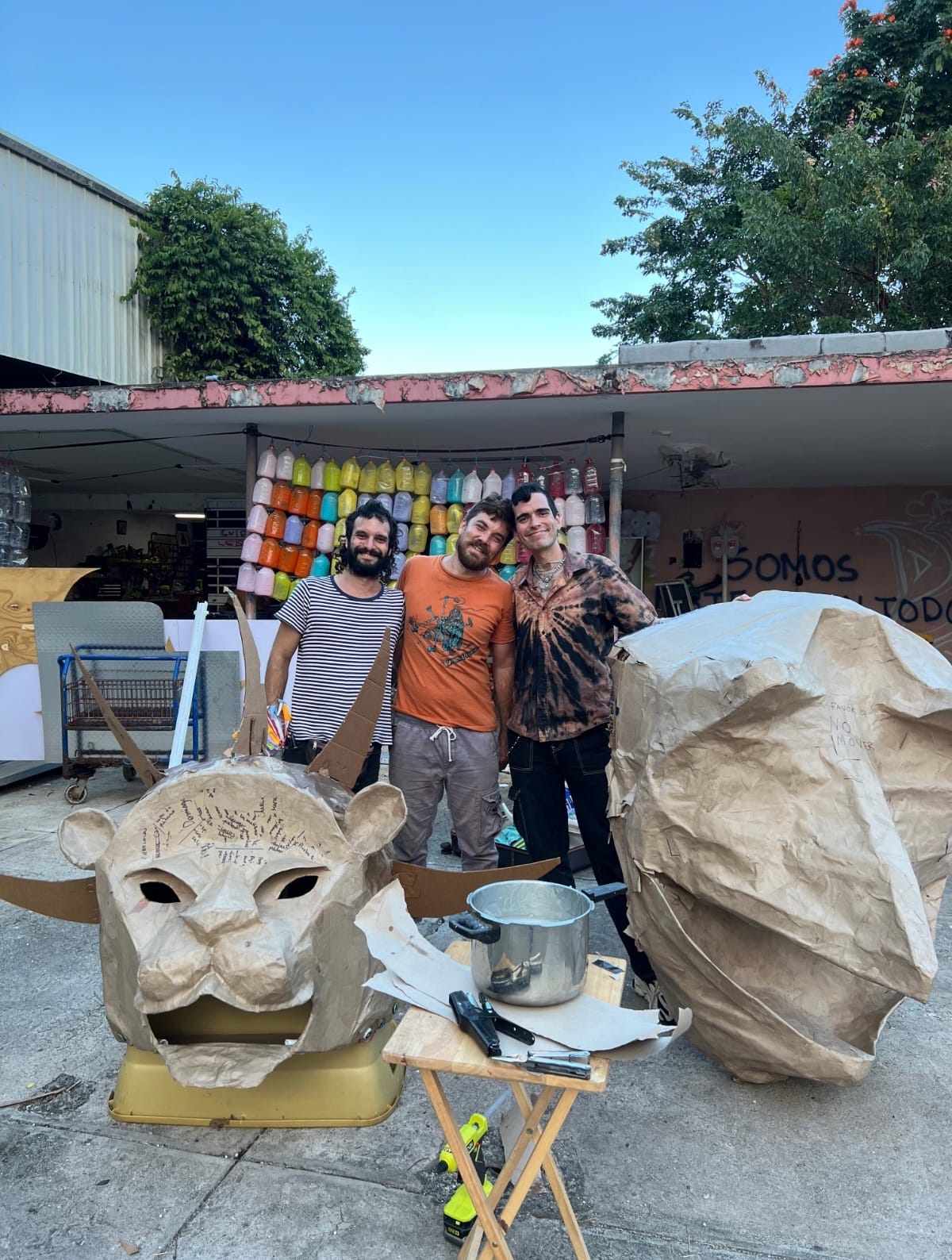
“My house is small and it was full. Sometimes I had between twenty and thirty people at a time here. I was working here and at a friends’ space who have a very big workshop,” Sanabria said. “That was the prueba de fuego [fire test]. I could not fail to any of the two projects because I wanted to be a part of the Ponce Carnival for a very long time. It was a dream come true.”
It was a dream come true, so he created two companies in which family and friends came together to help him with the great working challenge. The creative labor never stopped in between the carnival and Rauw Alejandro’s pieces. Sanabria considers him as the person who has contributed the most to the expansion of his familiar vejigante world.
The Familiar Vejigantes in Rauw Alejandro’s Mood Board
Through that ongoing collaboration, Sanabria created more than twenty pieces in 2025. These pieces toured around the world and it also opened more doors for new opportunities for Sanabria.
“Rauw told me: we had you on the mood board a long time ago, but we were waiting for the project to happen,” Sanabria said. “You never know in whose mood board you’re in. You just have to continue producing, post it, and keep looking out for each opportunity to do your thing.”
Don't Forget to Subscribe to
The Story of The Story
For only $16 a month, every Friday you'll have exclusive access to
The Story of The Story. Our founder, the Costa Rican award-winning multimedia journalist and artist Elizabeth Lang, guides you through her creative process to produce her stories.
That’s why in the middle of this story’s interview, Sanabria was still working on some of Rauw Alejandro’s masks. It’s been a continuous collaboration in which both artists have developed an artistic process where trust is at the center of everything. Sanabria describes it as a really open collaboration and it’s an ongoing conversation between them. Rauw Alejandro gives him a number of costumes and masks he wants done and Sanabria then comes up with the designs.
They then do the fittings to see if Rauw Alejandro and his dancers’ costumes and mask are well tailored. Once they try on the pieces, if certain changes need to be done, Sanabria carries them out until the clothes fit well.
Now, regarding the specific process for the “Carita Linda” music video and the Cosa Nuestra tour, Sanabria was given detailed instructions of what they wanted. First, they wanted black and white vejigantes. Then, for the other vejigantes, they let him choose the color combination.
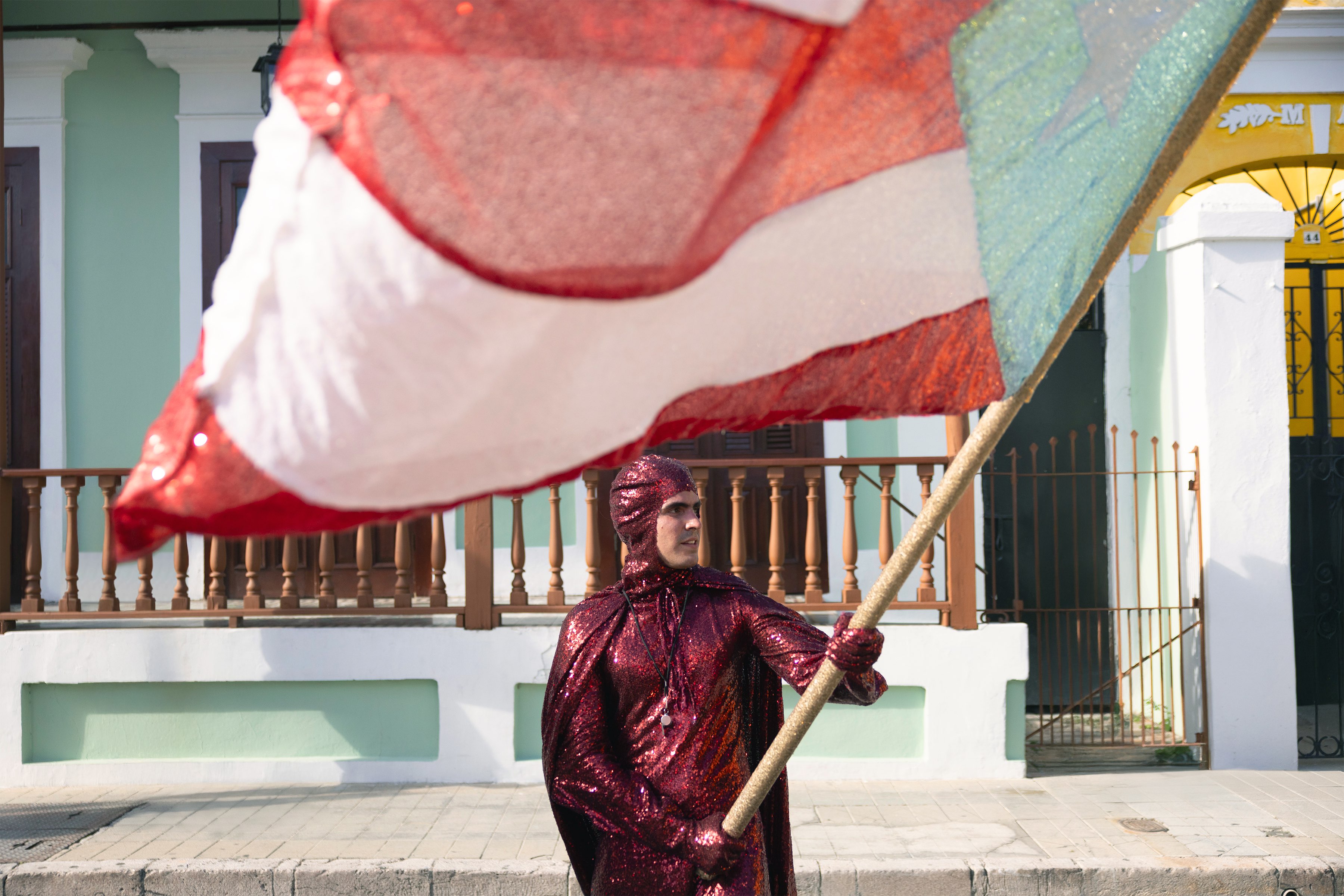
He then chose red and gold and was then told to do each vejigante twice. So, he had to do eight in total; four that were black and white and four that were red and gold. The reason as to why there were double vejigante costumes and masks was because they often tend to get damaged as the tour progresses.
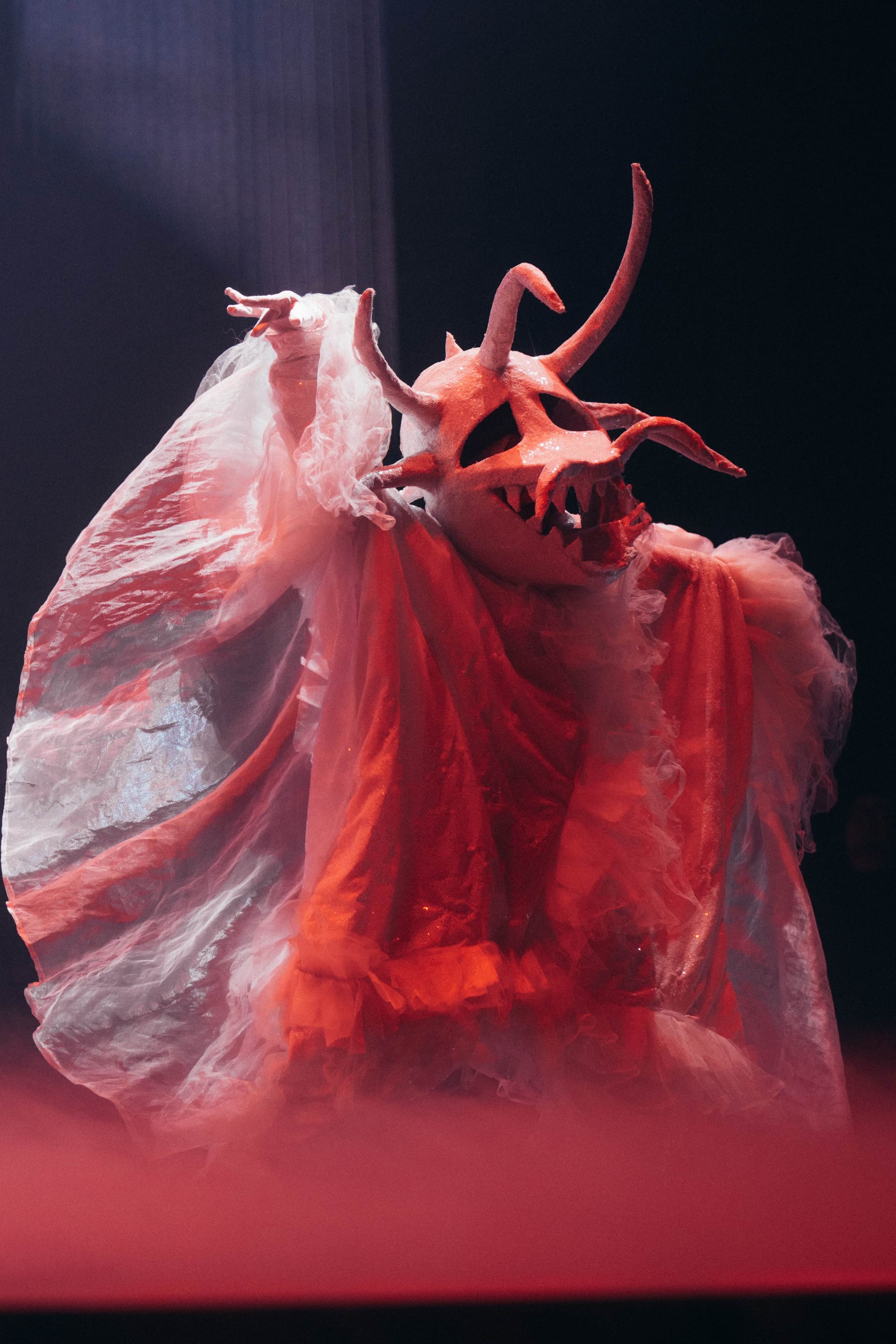
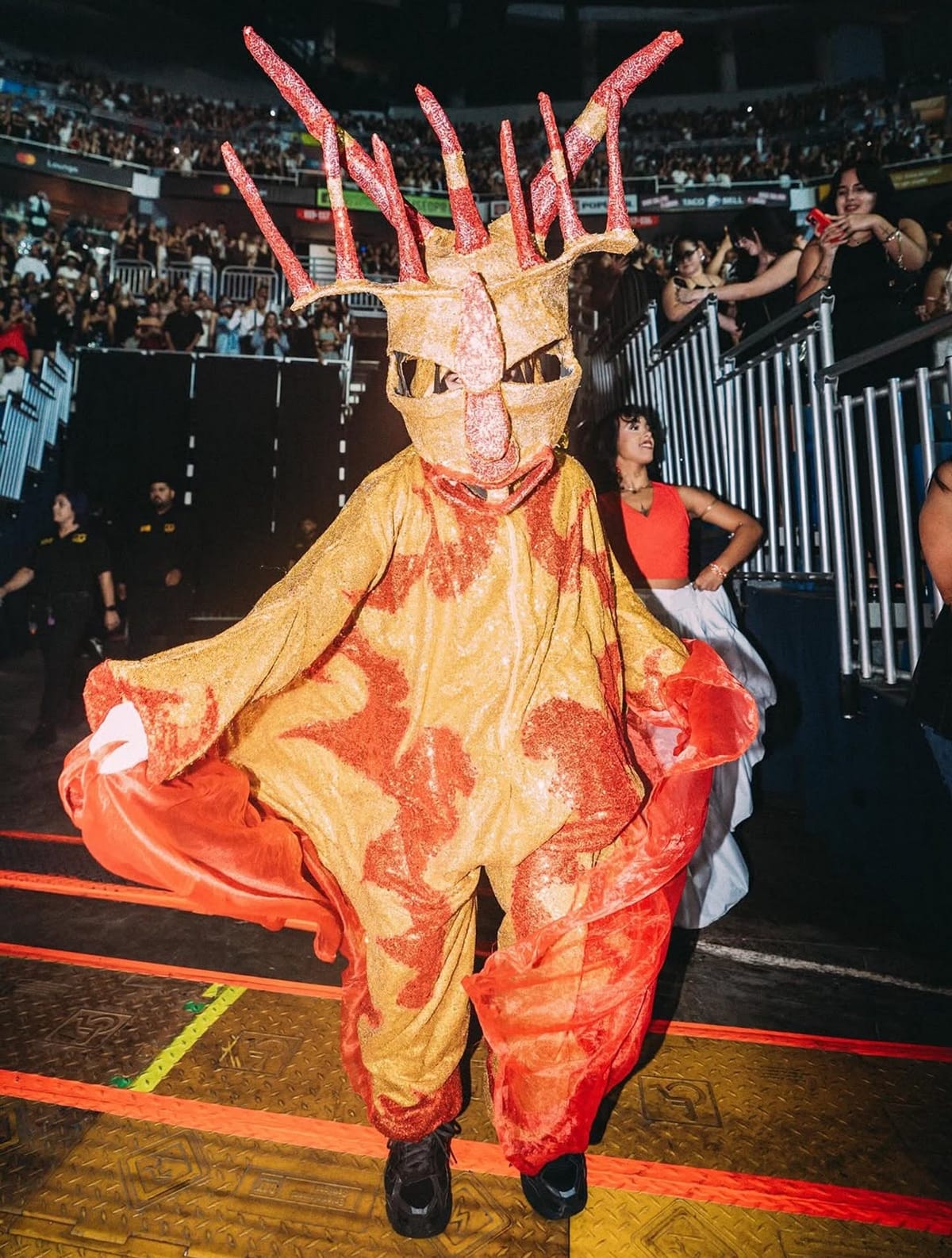
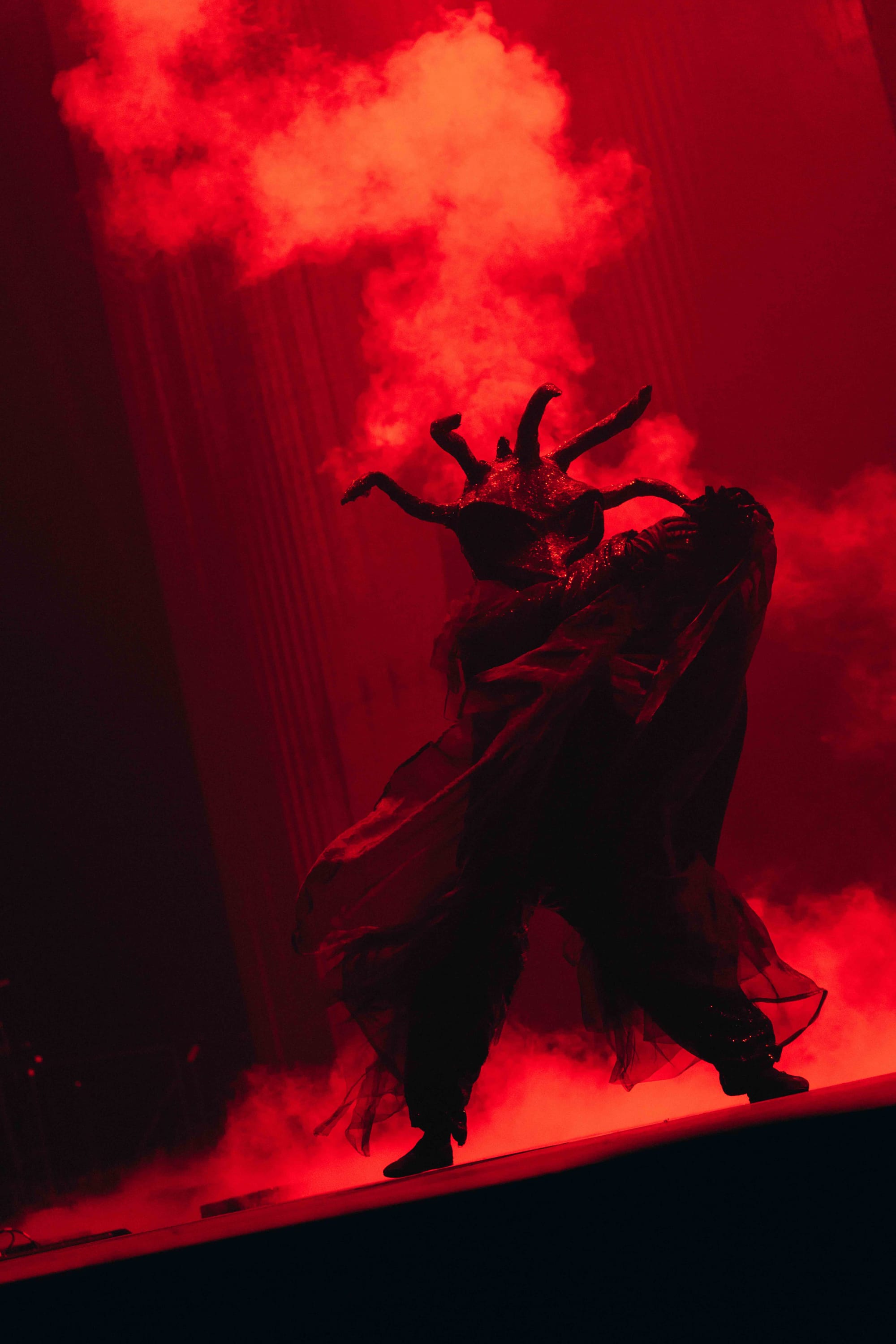
The vejigantes in action during Rauw Alejandro's Cosa Nuestra world tour in Belgium (left), Puerto Rico (center), and Spain (right). | Photos courtesy of Luis Gabriel Sanabria | Impulsiva Stories
“In that same conversation, he [Rauw Alejandro] said: so, for me, I’ll have a Paso Fino horse in that video and I want to dress up like a vejigante,” Sanabria said excited. “He told me: no one does the vejigantes like you. For a very long time I’ve wanted you [to do them]. I really admire you.”
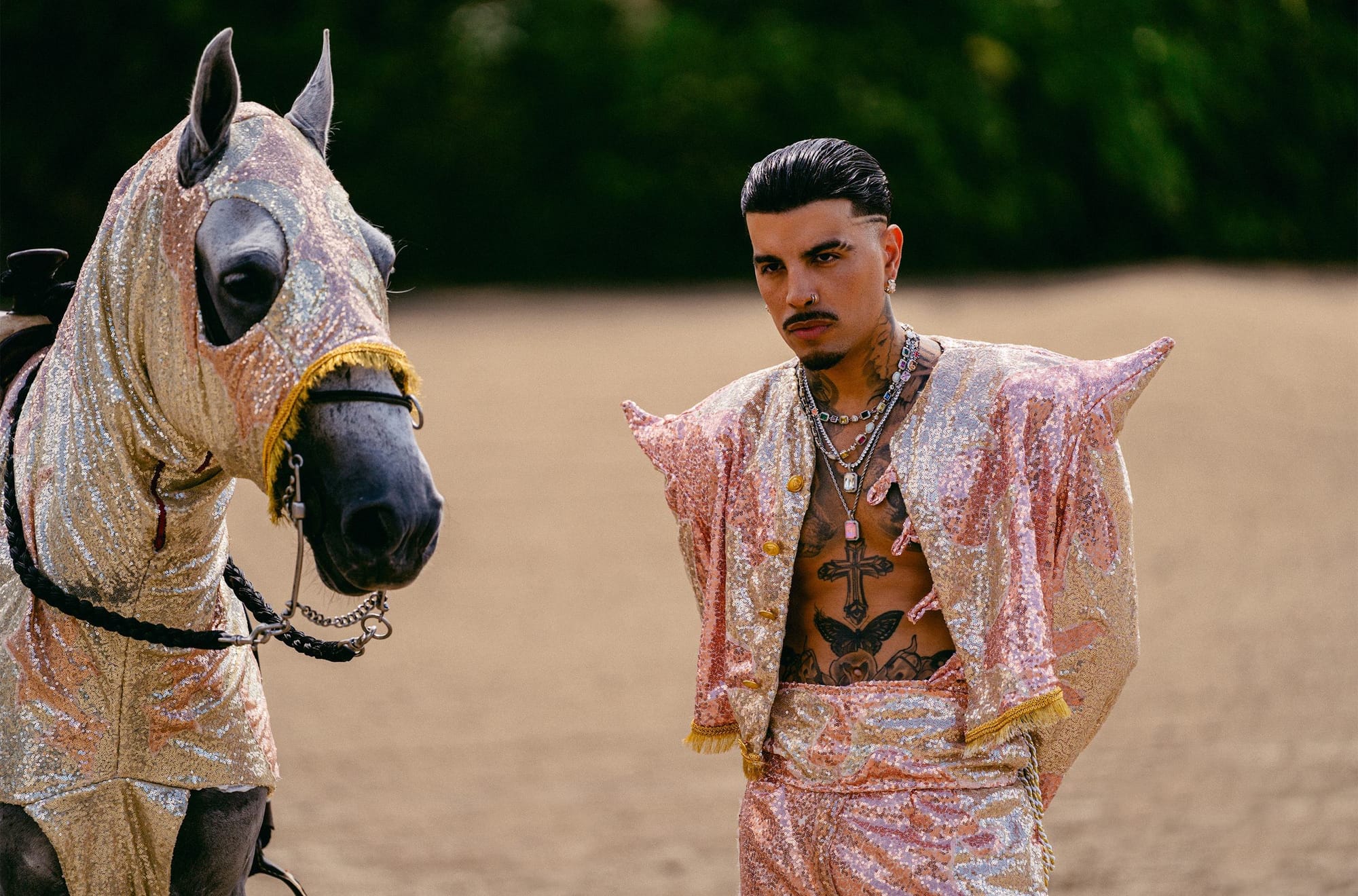
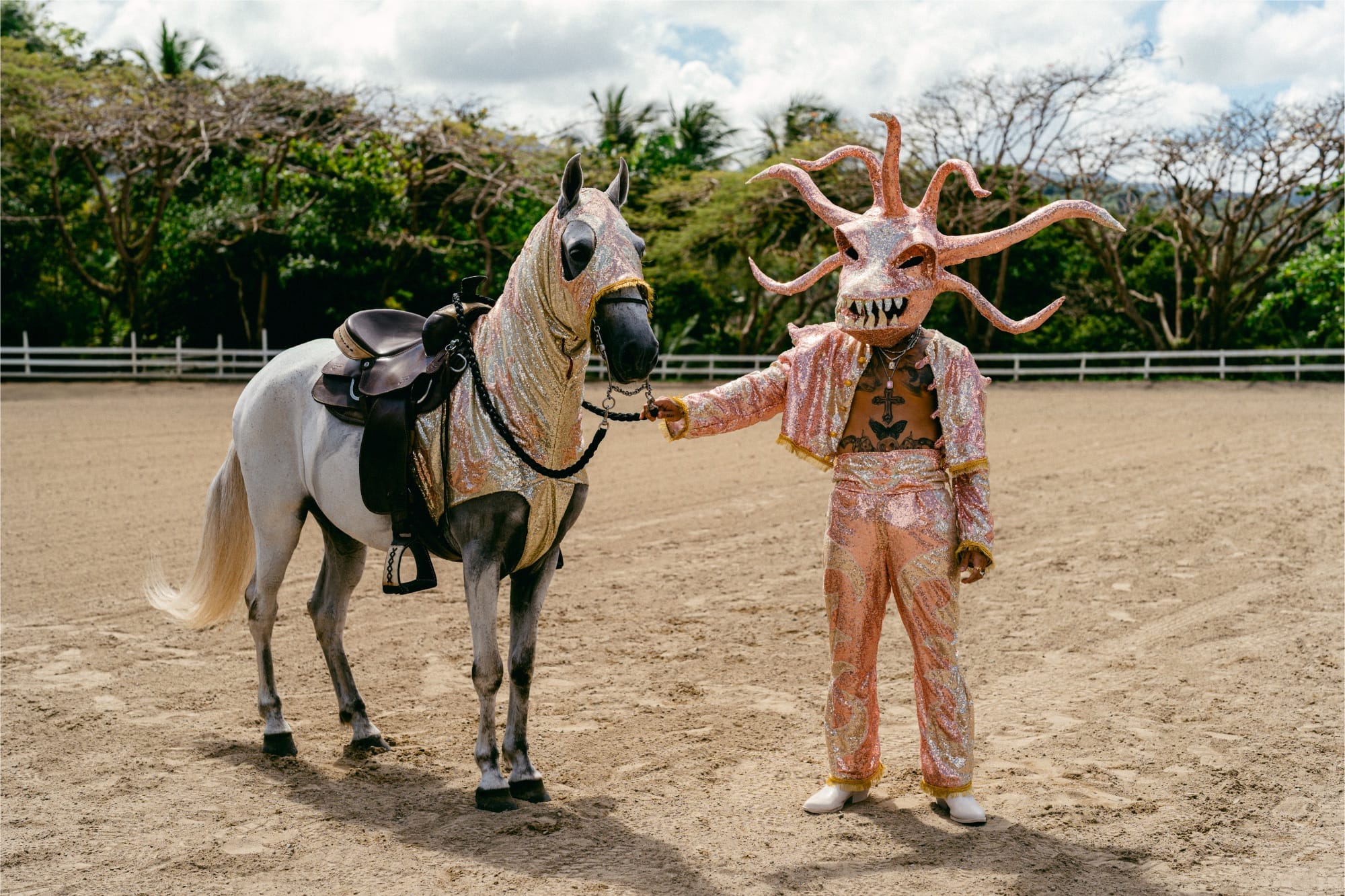
Rauw Alejandro dressed up as a vejigante for his music video "Carita Linda." | Photos courtesy of Luis Gabriel Sanabria | Impulsiva Stories
Sanabria still recalls with excitement that conversation and how these specific collaborations changed the path of his career in bringing the tradition of Puerto Rico into the modern and contemporary pop culture through mainstream music.
“And I was like: ayyyyy, no. He said: really, I identify myself with you. And I was like: ok. He’s super cool and super nice. In that first meeting I asked what color,” Sanabria said. “He said: look, mano de verdad [brother really], use whatever color you think is right, but it has to be pastel.”
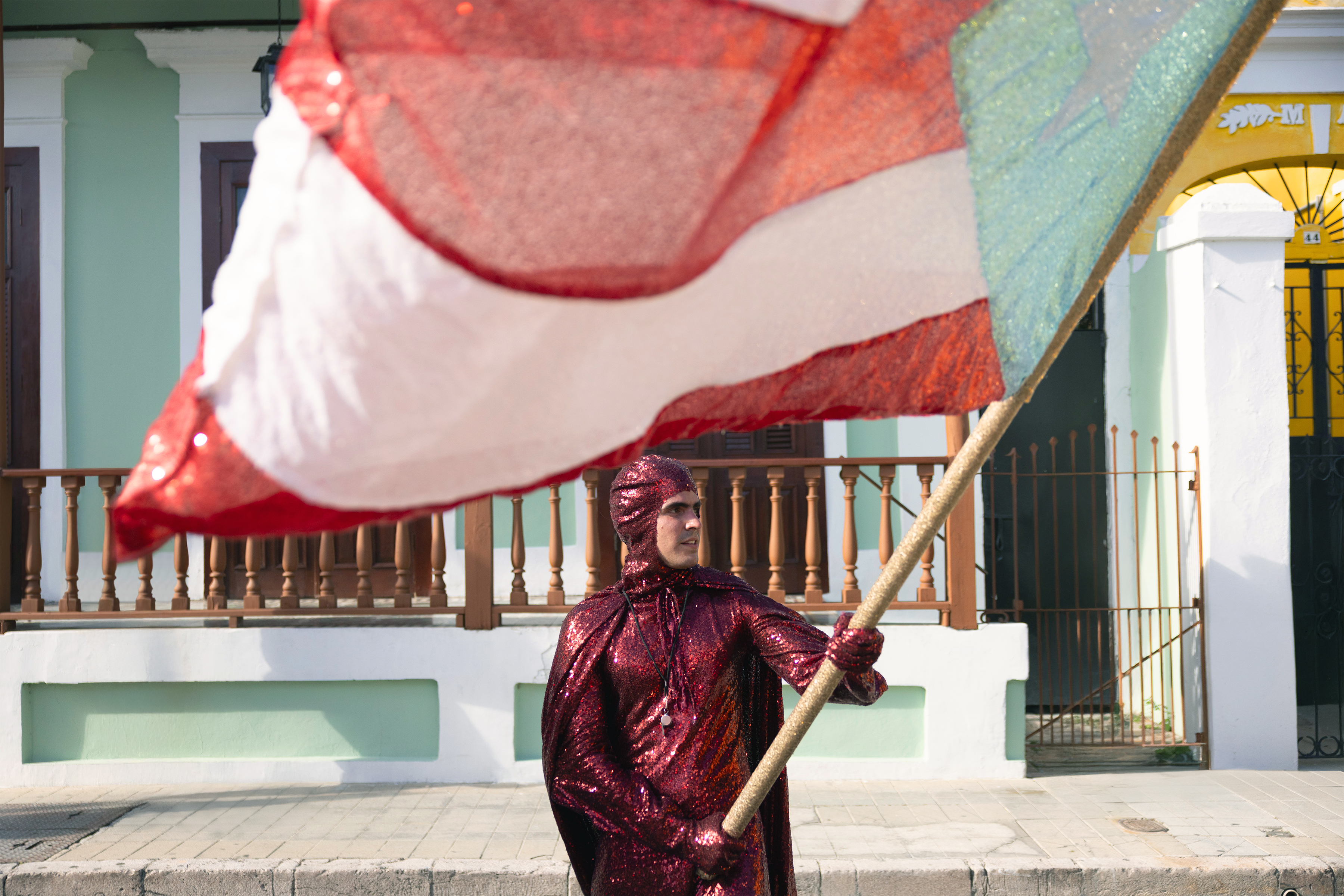
Listen to Luis Gabriel Sanabria
0:00
/104.861333
As soon as he was told to use a pastel color, Sanabria thought right away about using pink. There was no hesitation and doubt about that bold choice.
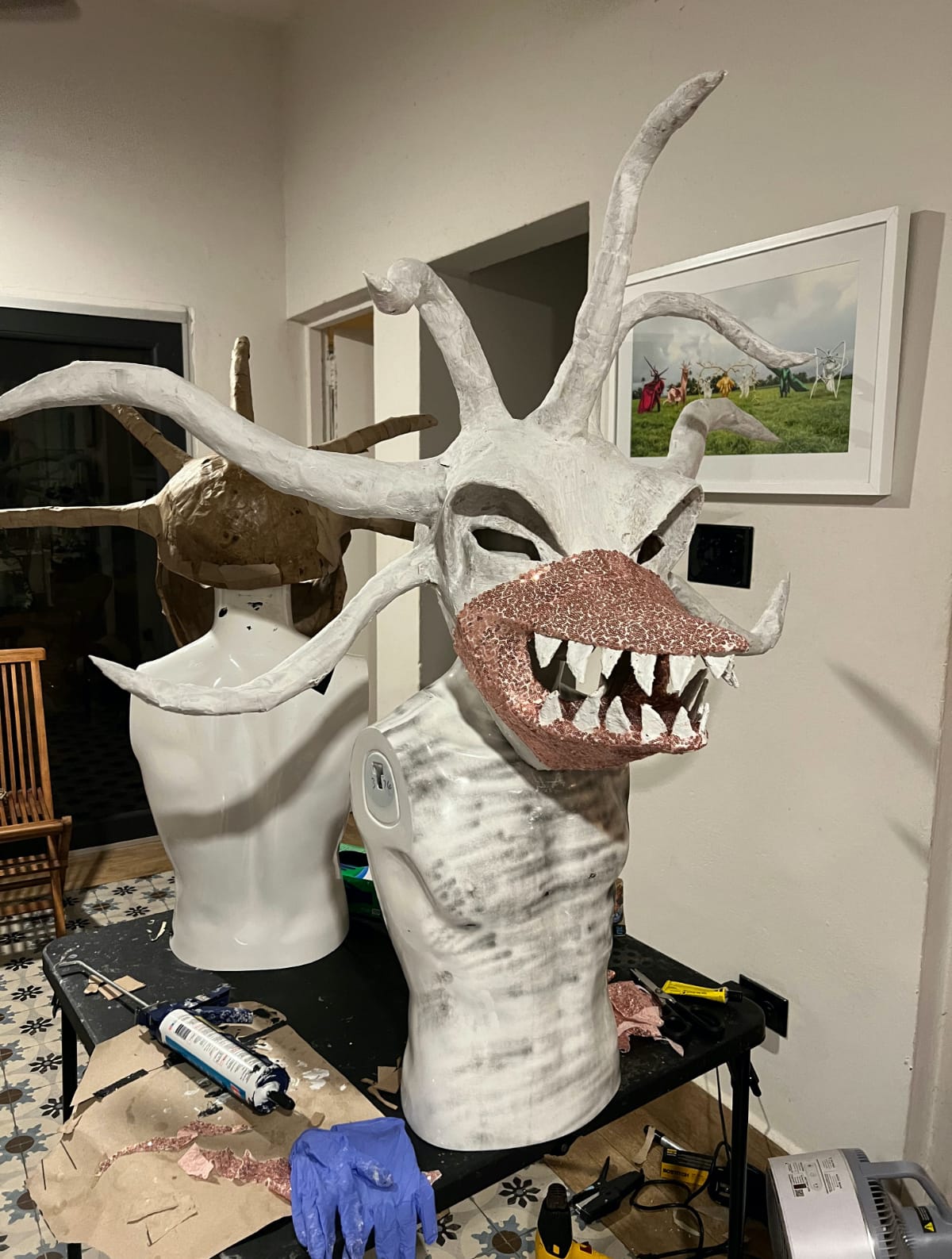
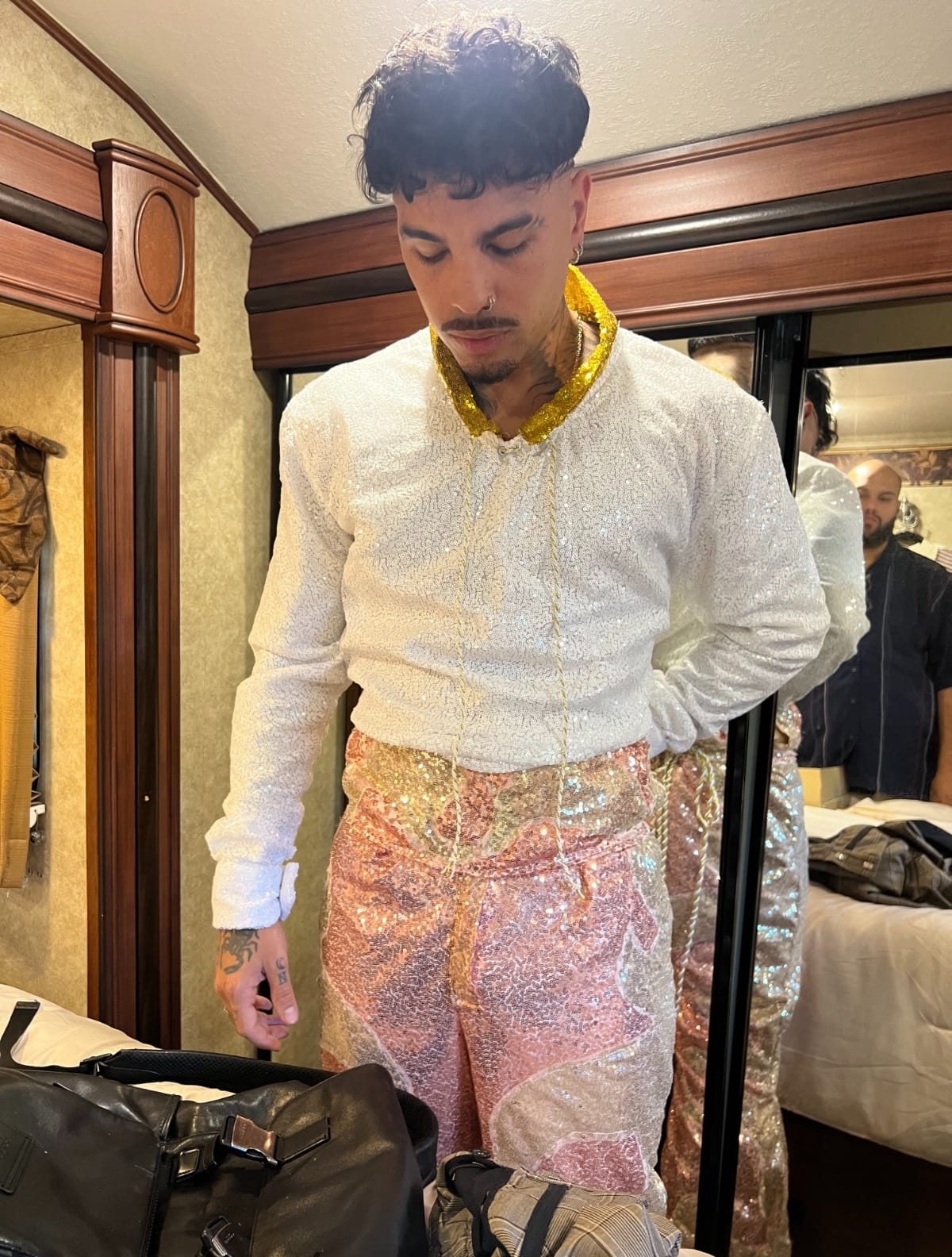
The process to create the vejigante mask and costume for Rauw Alejandro's "Carita Linda" music video. | Photos courtesy of Luis Gabriel Sanabria | Impulsiva Stories
“When we did the fittings, he was like: no one does this like this. No one has this. This is going to change a lot of things,” Sanabria recalled. “And I was like: that’s so nice. Thank you. I also think that. It’s a super statement.”
And then, Sanabria and his team came up with a new idea. They offered Rauw Alejandro to dress up the horse, which came with a set of new challenges. Sanabria and his team, made up by his friends Rocío Cáliz, Paula Orro, and Maite Reyes, had never dressed up a horse before. They were also a bit constrained with time because of simultaneously working for the Ponce Carnival and Rauw Alejandro.
For the horse they didn’t have a sewing pattern, so Sanabria ordered one online. He did not know the specific measurements for the horse, so he ordered the biggest pattern available. He knows that when they cut the fabrics, they get smaller and the sequins fabrics – that are a staple of his vejigantes – do not stretch that much.
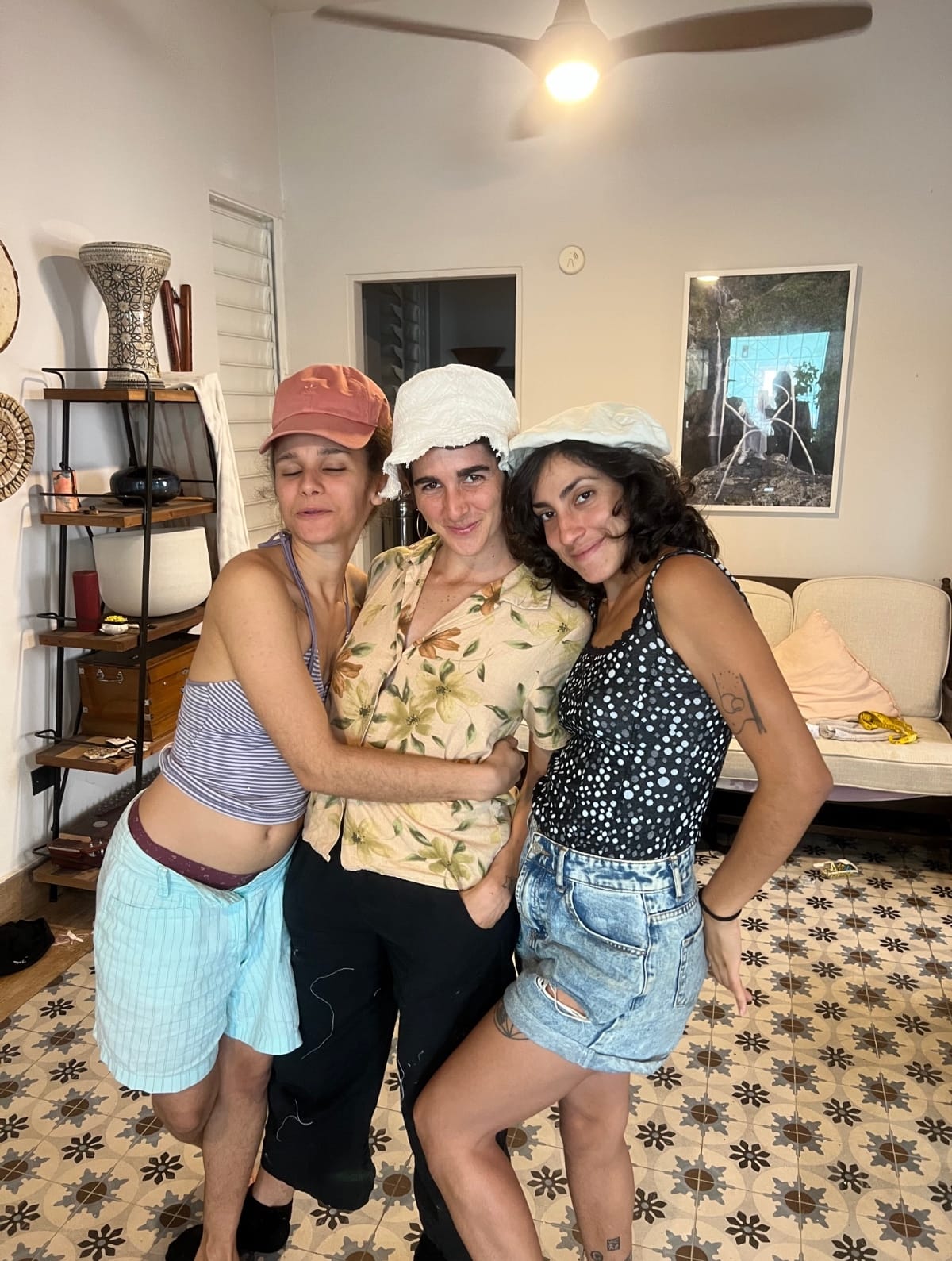
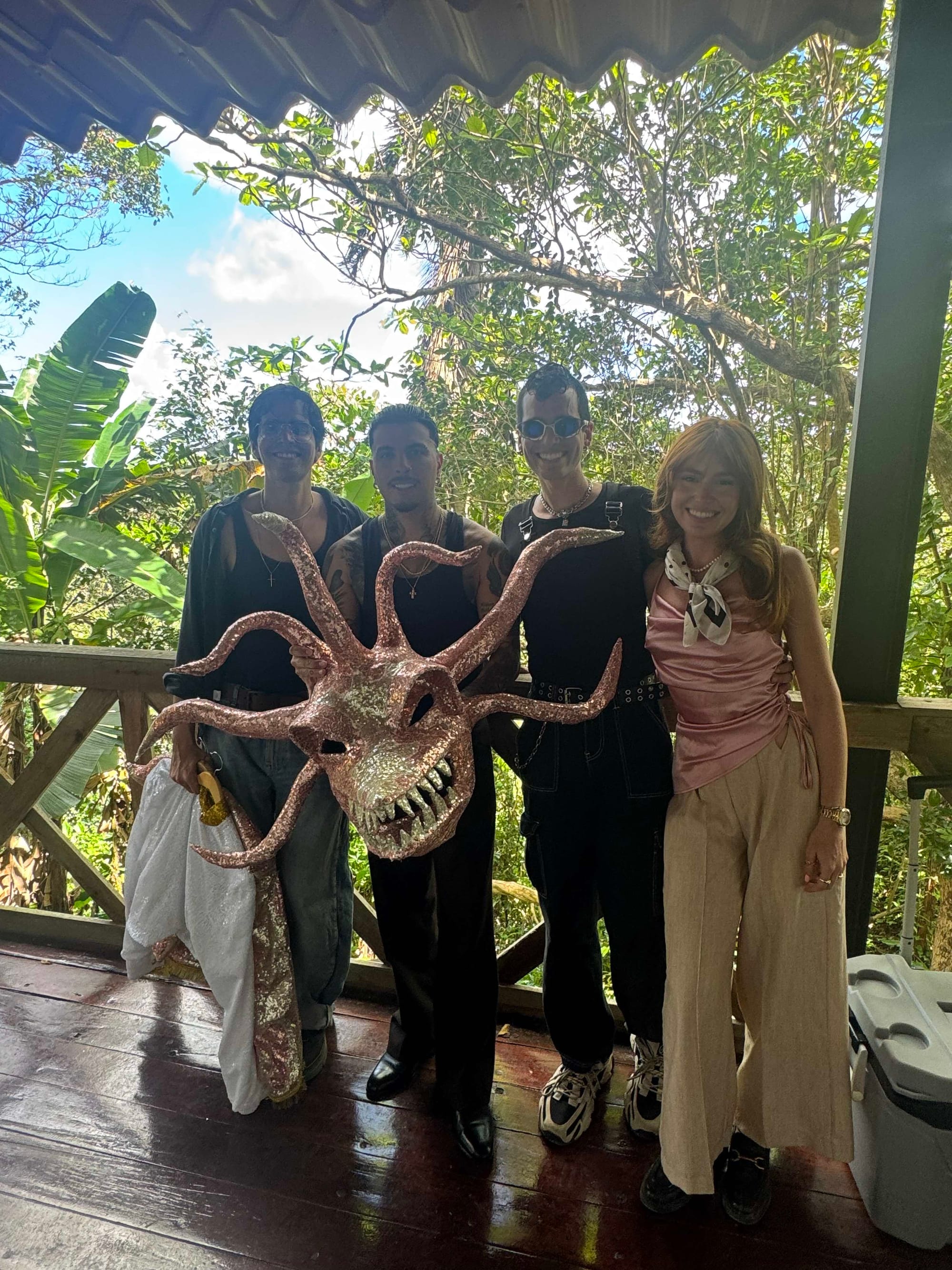
Maite Reyes, Paula Orro, and Rocío Cáliz (left) and Luis Gabriel Sanabria and his team with Rauw Alejandro (right). | Photos courtesy of Luis Gabriel Sanabria | Impulsiva Stories
Once the sewing patterns arrived, they cut them and traced them. They only had one fitting for the horse.
“One. And it was like: look, this has to be out now,” Sanabria said. “We made some adjustments, but it needed to be done. In the end, there was something in the positioning of the eyes that needed to be more comfortable for the horse.”
The filming of the scene with the horse was in Río Grande, which was about an hour or more away from Sanabria’s studio. He remembered that each second was vital in the process for this particular music video. It was a crazy experience – as he described it – but one in which he learned so much and enjoyed the creative process.
Pastel Pink as an Edgy Statement Piece
These were custom-designed masks and clothes that became a statement piece. Not only because of portraying a man wearing a beautiful pink and shimmery vejigante design, but also because in recent contemporary Puerto Rican culture, no one had showcased a vejigante as a horse rider before.
Regarding the pink color, Sanabria didn’t give it much thought because he knew Rauw Alejandro was sharing with the world a multidisciplinary project that was re signifying Puerto Rican culture in many ways. Sanabria considers it a project that breaks paradigms within tradition and that’s one of the reasons why he immediately thought of pink.
“He said a pastel color and I had in mind some sort of light blue. Very nice, but it was very predictable and pink also creates a great contrast with the natural environment,” Sanabria said. “I know that because I had already created a pink dragon, which is one of my favorite pieces. I kept that idea and that very subtle color combination came through. That light gold and pink. That’s how it had to be.”
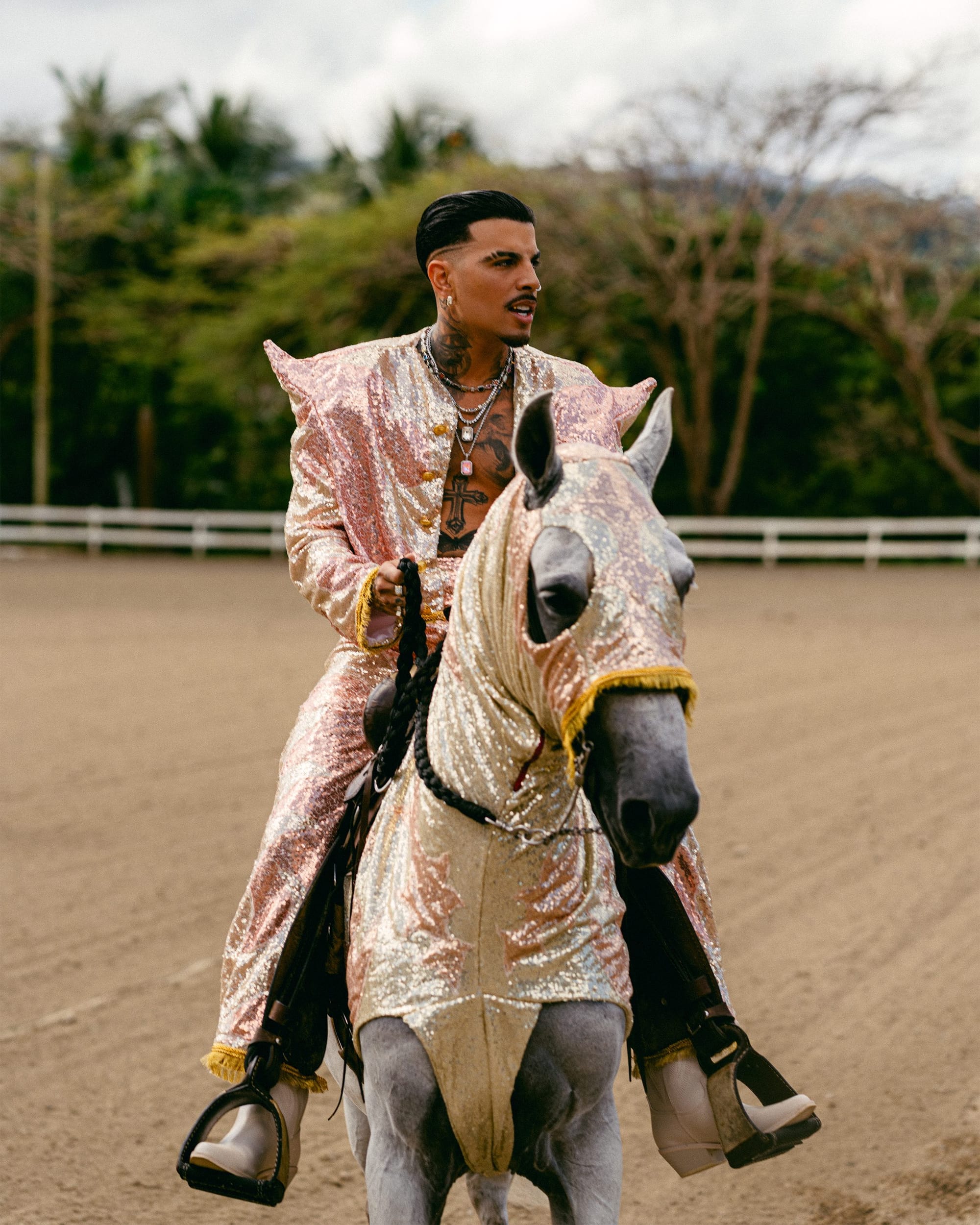
The color choice was a natural one and it served its purpose of defying stereotypes. He knew Rauw Alejandro would love it because it’s quite edgy. And being edgy through colors is one of Sanabria’s defining staples. The color choice is an active and conscious decision.
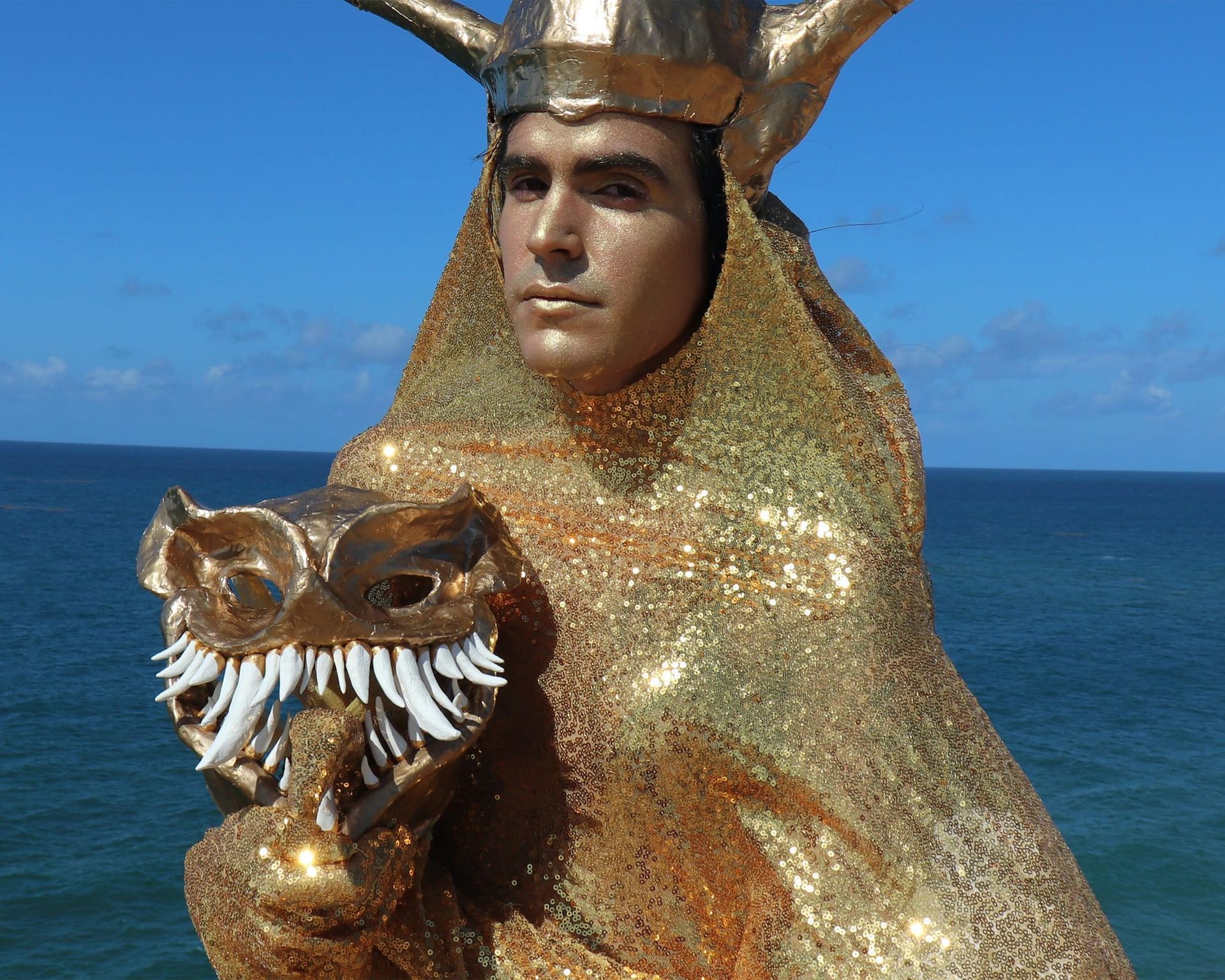
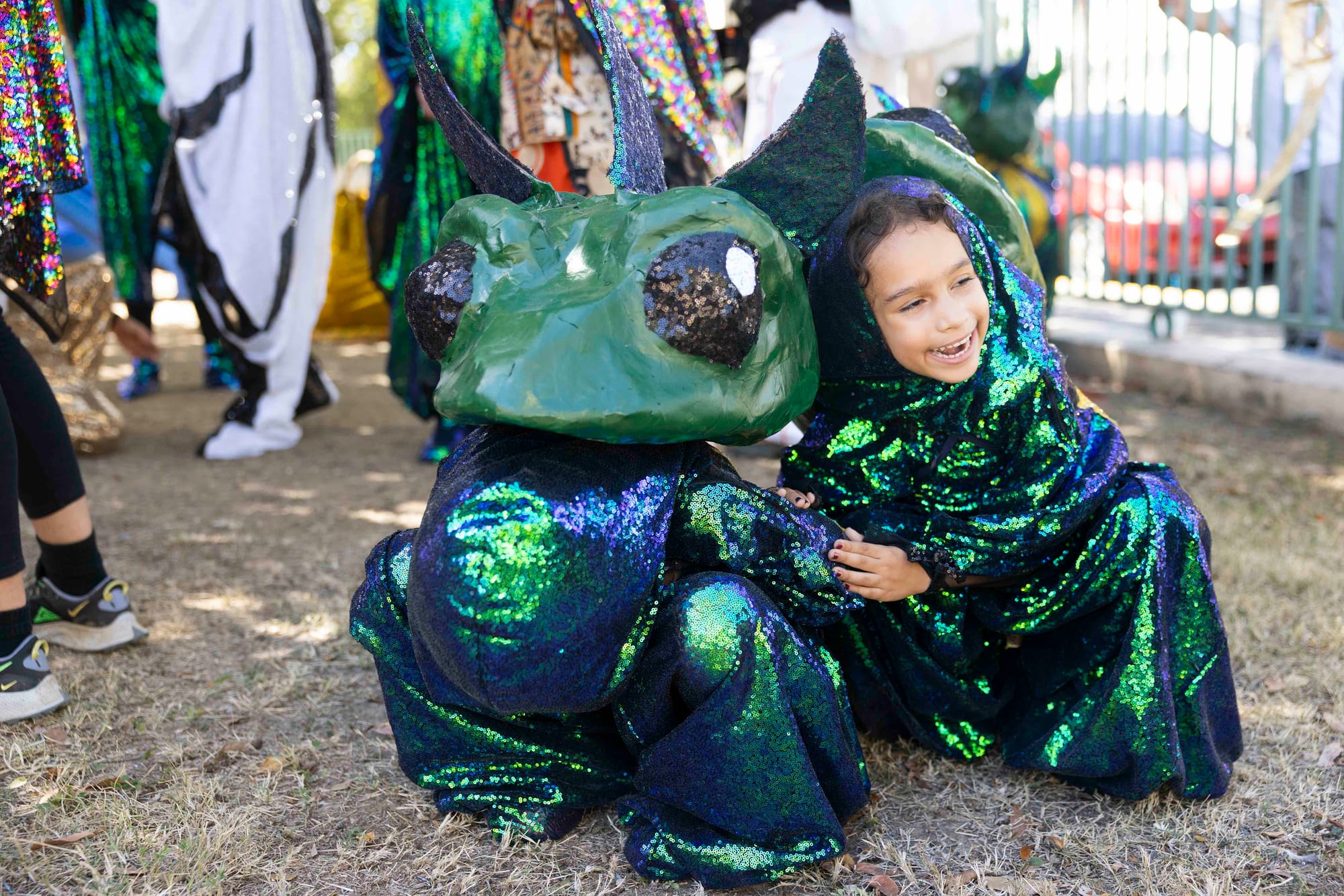
The reason why Sanabria’s vejigantes are so mesmerizing and breathtaking is because of his impeccable use of sequins. He discovered the sequins fabrics by accident and once he found them, there was no way back in his creative process. He loved the iridescence the sequins create and the possibilities it gave him. Within those possibilities, he fell in love with how the sequins reflect light and its capacity to change color tones with the wind and light around it.
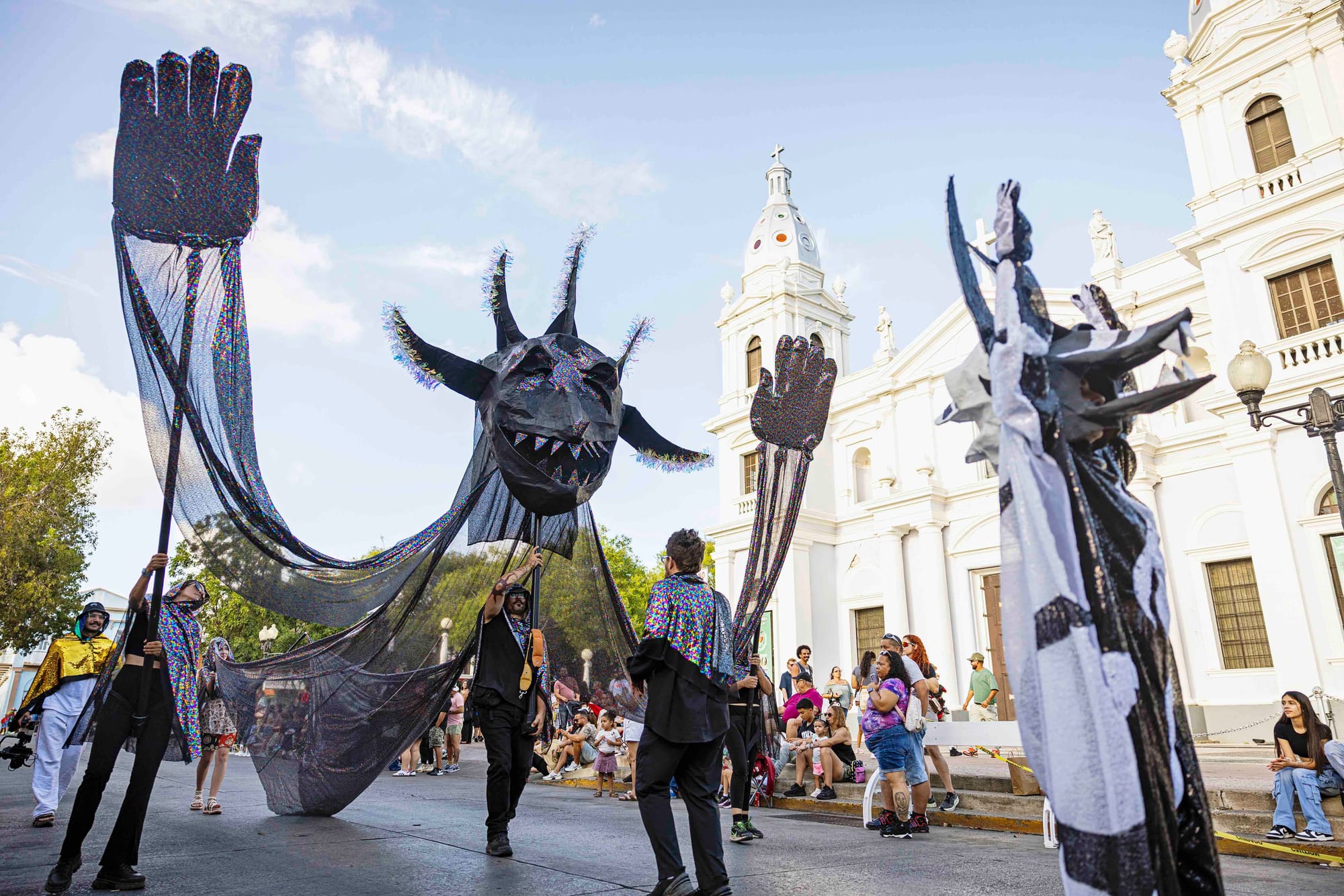
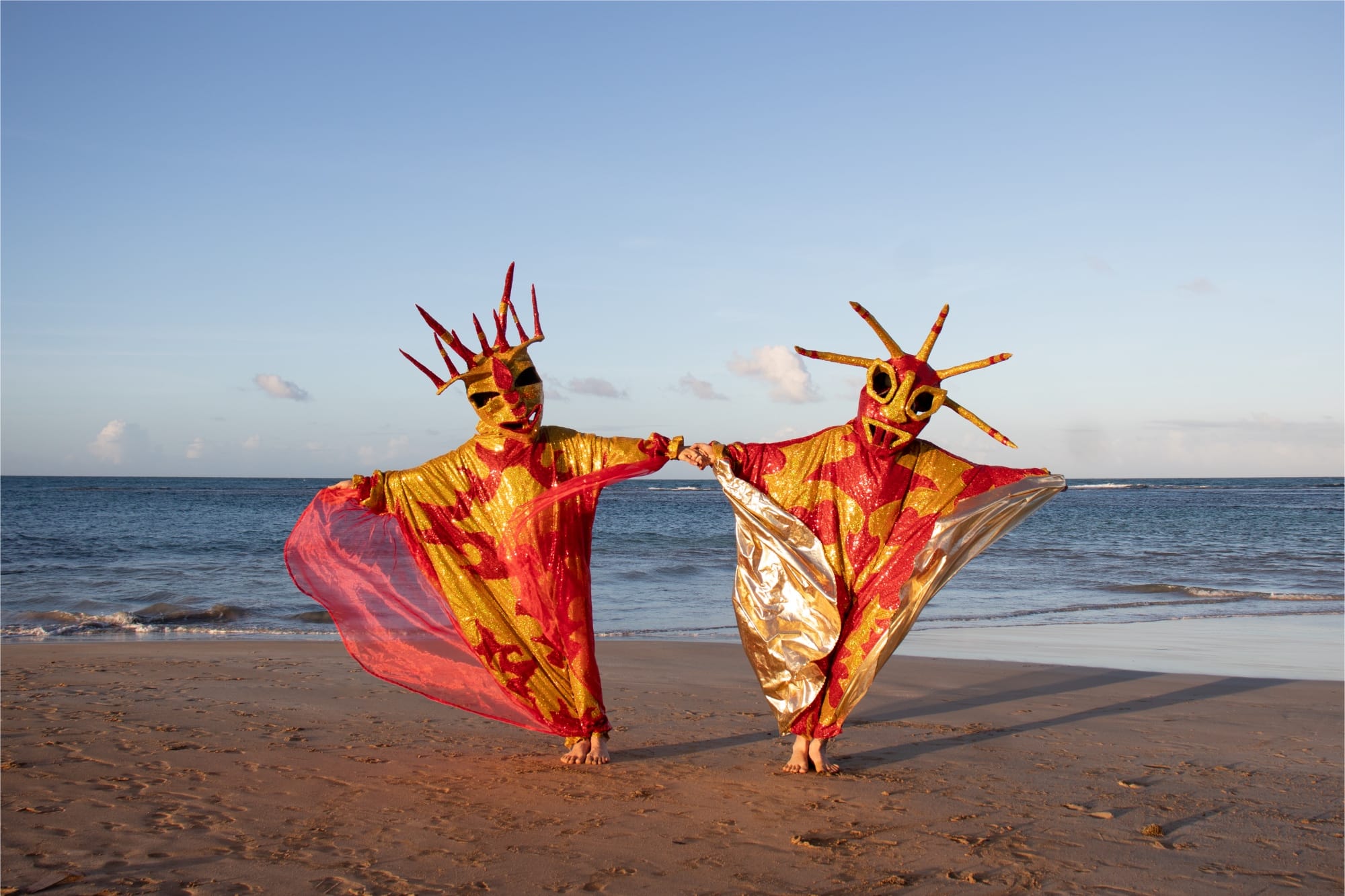
The shiny and shimmery breathtaking aesthetic thanks to sequins fabrics is a staple of Luis Gabriel Sanabria's vejigantes. | Photos courtesy of Luis Gabriel Sanabria | Impulsiva Stories
These bright sequins are in great part the reason why Sanabria’s familiar vejigantes merge tradition and contemporaneity so naturally. It’s part of his artistic language, which is also in tune with Rauw Alejandro’s ideas.
This common artistic language between them is not only reflected in their love and passion for vejigantes, but also in the direct connection they portray between music and art.
“The carnival and these figures [vejigantes] are very linked to bomba music. Rauw Alejandro’s musical project explores what he now calls as neo-bomba, or his re interpretation of Puerto Rican bomba music,” Sanabria said. “There are also elements of plena, but the vejigante is very tied to this type of music. It’s one of America’s oldest musical genres.”
According to Sanabria, bomba is a product of colonization and creolization in Puerto Rico in which African, Indigenous, Creole, and European elements came together.
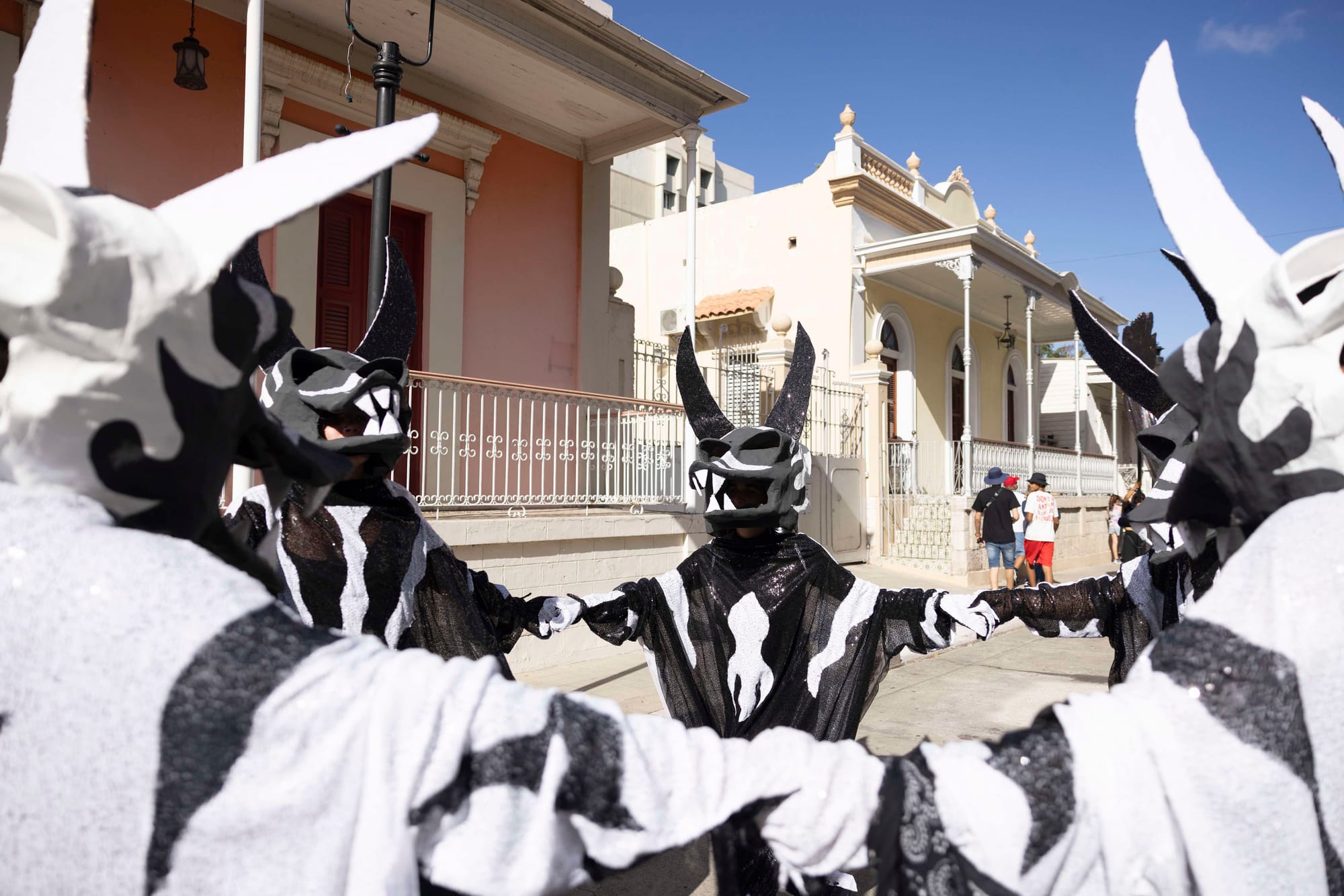
“So, I think that the music goes with the character and I think the resonance that it has today for the musicians has a fantastic element, but also a political element. It has to do with those stories. Those stories here that are a lot about resistance and resilience,” Sanabria said. “What bomba and traditional music have done is the representation of these characters.”
Painting a Vibrant “Besito en la Frente”
The representation of these characters exists in a stylistically varied form in Sanabria’s art of his familiar vejigantes. They can pivot aesthetically and that’s evident in the different style he created for Rauw Alejandro’s “Carita Linda” music video, his Cosa Nuestra tour, and his latest music video “Besito en la Frente.”
You can see a clear evolution in Sanabria’s vejigantes from “Carita Linda” to “Besito en la Frente.” The music video for “Carita Linda” was released in April of 2025 and “Besito en la Frente” in November of 2025. The styles are different, but the essence is the same. “Besito en la Frente” was a collaboration with Apple, so the music video was shot on an iPhone 17 Pro.
“They reached out and told me: look, we need you to do the masks for us. We had two weeks for that. I told them I wouldn’t use sequins. I did do what is usually done [for vejigantes], which is painting with acrylics and then varnish them,” Sanabria said. “In the end, the vejigantes are shiny because they’re varnished.”
However, Sanabria said that the paint style was not the traditional one because the artists usually resort to the technique of pointillism with different colors. Instead, Sanabria used solid colors that were in the color palette given by the team’s costume designer and film director. Sanabria ended up working with different color blocks that he associated to the feeling that the project was giving him.
He really loved the final result of the vejigantes and how they were used in the cinematic introduction of the music video narrated by Rauw Alejandro. It was a challenging experience where he could share with the world how Rauw Alejandro and Puerto Ricans perceive the figure of vejigantes. Where they come from and how they look in their cities and natural environments.
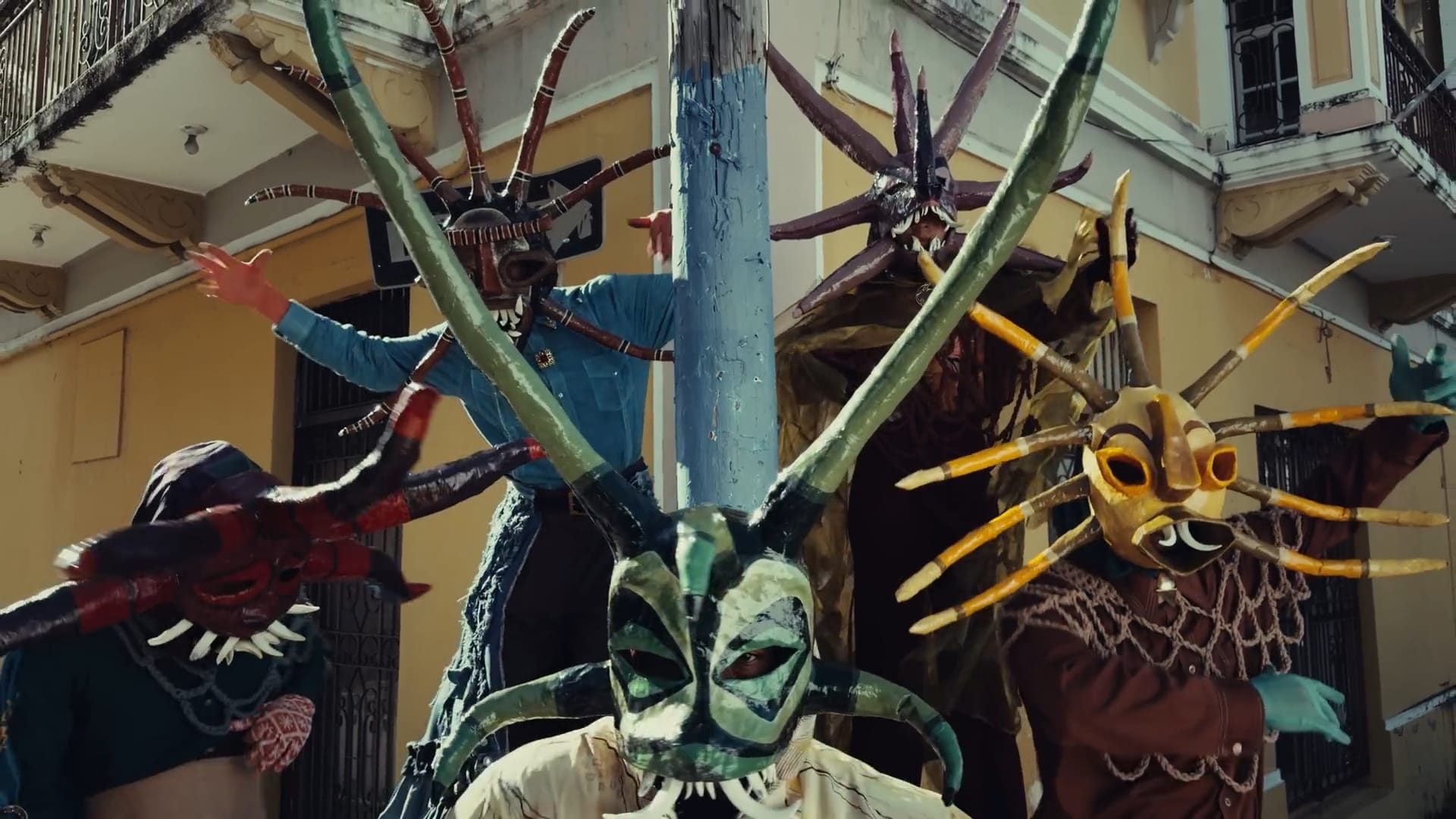
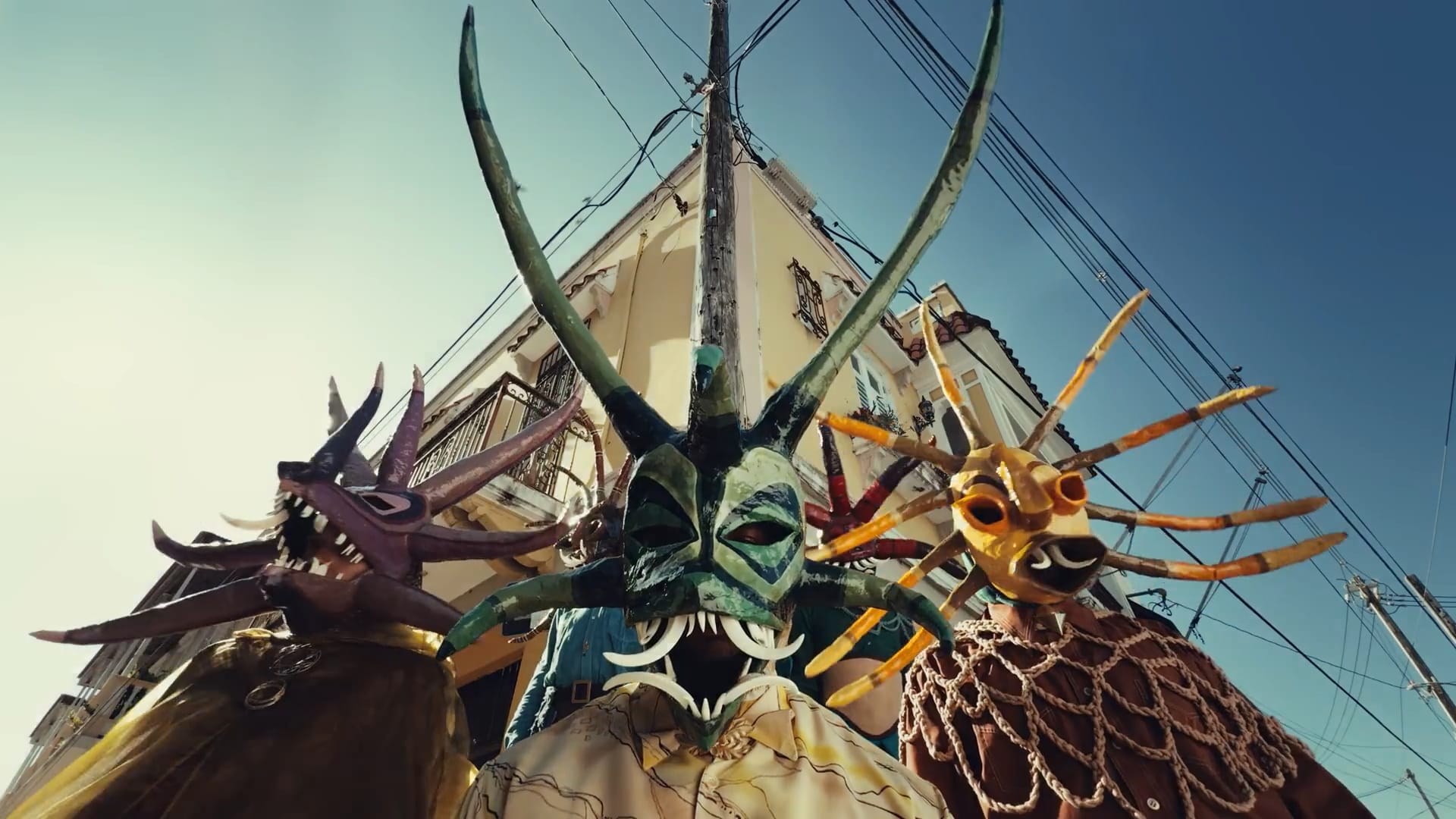
The vejigante masks Luis Gabriel Sanabria created for Rauw Alejandro's "Besito en la Frente" music video. | Photos courtesy of Luis Gabriel Sanabria | Impulsiva Stories
This allowed Sanabria to explore certain forms and paints that he usually doesn’t experiment with. It’s part of his art of familiar vejigantes that innately portrays both Puerto Rican and Latin American identities in a natural manner.
“They’re present in that idea of how I can approach this from my own point of view. I do recognize that they’re practices that stem from tradition and the day-to-day, but also from that familiar gathering,” Sanabaria said. “It’s the sense of community that gives that Puerto Rican and Latin American sentiment.”
For Sanabria, it’s about the familiar energy that Latin American people have. It’s also an art that can fight back division and hatred in the region. Sanabria would like for his art to inspire more of what unites the people of Latin America and he believes that when there are certain symbols involved, it’s easier for people to identify with each other. That’s why he considers his art as a strong statement in which what’s familiar creates a sense of unity through identity.
0:00
/0:42
Introduction of Rauw Alejandro's "Besito en la Frente" music video. | Video courtesy of Luis Gabriel Sanabria | Impulsiva Stories
It's also art that reflects his pride of being Puerto Rican, Caribbean, and Latin American. It’s art that made it to pop culture with his familiar vejigantes in the Ponce Carnival and Rauw Alejandro’s music videos and Cosa Nuestra world tour. It’s art in which he reflects about the potential that Latin America has as a cultural powerhouse.
“I think we’ve been erased a lot and our history as well. We’ve been told what we are. They’ve moved us and exploited us. It’s time for them to see us as a cultural powerhouse,” Sanabria said. “We’re giant powerhouses and that’s what inspires me. Not only with the Puerto Rican art, but with the Caribbean and Latin American art.”
To learn more about Luis Gabriel Sanabria’s familiar art of the vejigantes, you can follow him on Instagram at @luisgabrielsanabria.art.
Written by

Subscribe to my newsletter
Subscribe to my newsletter to get the latest updates and news